The PCSA Targeting Memo:
Data & Methods
Every senator, every documented conference position, every threshold I chose — the full apparatus behind the consulting memo nobody commissioned.
Read the essay Download the spreadsheetThe figures
Right-click any figure to save it; the spreadsheet behind all of them is in the downloads below. Color logic throughout: blue Democratic caucus, red Republican, gray = documented SEC/Big Ten opposition money, pale fills = the weaker documented-support tier, white diamonds = net pressure.


Downloads
- pcsa-path-to-60-v3-full-evidence.xlsx — the main dataset: 100 senators × 18 indicators, 131 schools with evidence tiers, whip-count sheet, README with every choice documented.
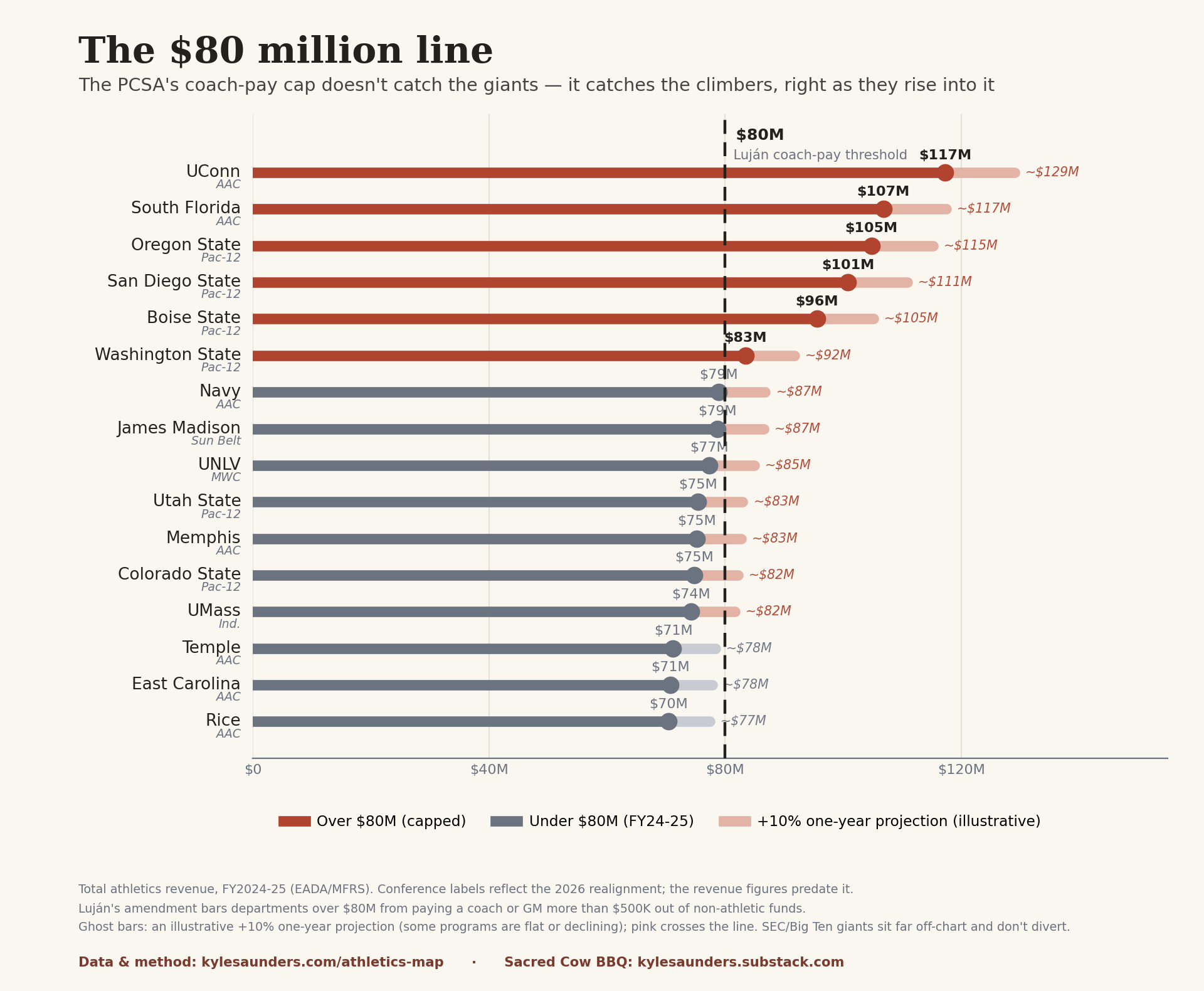
Athletics revenue and conference affiliation come from the athletics finance map (The Whole D1 tab; institutions v6.3, with thanks to Dr. Greg Chick), and reflect the last completed reporting year. Positions are as of June 10, 2026; the July 2026 realignment is not reflected. That's the trade you make when you insist on receipts.
Methods, briefly
The evidence tiers
| Tier | What counts | Who's in it |
|---|---|---|
| T1 SUPPORT | Formal post-introduction letters to Senate Commerce; institutional letters trump conference positions | ACC (5/31), Big 12 (5/31), American (6/3), Sun Belt (6/9); institutional: Nebraska (5/27), UTEP (6/2), LSU (6/1, over its own conference's objection) |
| T2 SUPPORT | The May 15 letter signed by 26 of 32 D1 commissioners (pre-text, hence the weaker tier) and documented testimony | MWC, MAC, CUSA; Pac-12 (Gould testimony, 6/3) |
| OPPOSE | Joint statement, oppose as written (6/2) | SEC, Big Ten |
Vibes don't score. Conference-office positions are imputed to member schools' revenue, with the caveat the essay names: offices aren't schools, and LSU proves it.
Senator-level variables
- Pressure: sum of home-state FBS athletics revenue by tier; net = support − oppose. Categories cut at ±$100M net, a threshold that sits in a natural gap in the distribution (nothing between −$150M and −$62M), so the defection tail is robust to any cut from −65 to −150.
- Ideology: DW-NOMINATE (both dimensions), Voteview S119.
- Electoral exposure: Cook PVI 2025 (state values via the Wikipedia mirror, validated by recomputation from official 2020/2024 returns: 48 of 50 exact at a ~70/30 recency weighting, the other two off by rounding); Trump 2024 two-party margin from official returns; ballot status, retirements, and gubernatorial runs flagged.
- Flags: Senate Commerce membership; SAFE Act (S.2932) sponsorship; CBC membership; sponsor status.
Robustness
Built on athletics money, checked against whole-institution revenues: the two only correlate moderately at the school level (r = 0.59; hospital systems), but the senator-level nets correlate at r = 0.89 and agree on the support-or-oppose sign in every state except net-zero Kentucky. The map is robust to that choice. Senator roster verified against the three 119th-Congress vacancies (OH, FL, OK, all filled by appointment).
The public grading sheet
The memo gets graded against reality. These are the falsifiable predictions on file as of June 10, 2026; this table gets updated, not rewritten, after markup. Markup results are filled in below (June 18, 2026); the floor-stage calls remain open. Through markup, the sheet stands at four hits, two misses, and three calls still open.
| # | Prediction | Confidence | Check at | Result |
|---|---|---|---|---|
| 1 | PCSA is reported out of Commerce | High | Markup | Hit — 19-9 (June 18) |
| 2 | No more than 2 of the five watch-list Commerce Democrats (Markey, Rosen, Luján, Hickenlooper, pool-adjacent Schatz) vote aye in committee | Medium | Markup | Miss — 4 of 5 voted aye (Rosen, Luján, Hickenlooper, Schatz); only Markey no. A miss on the count, off by two: the named targets were exactly right, the pool just moved more than predicted. |
| 3 | At least one tail Republican on Commerce (Blackburn, Young, Wicker) offers or cosponsors an SEC-aligned amendment | Medium-High | Markup | Hit — Wicker filed SEC-aligned amendments (85% pooling threshold; non-participant liability shield). They were not adopted; his adopted Wicker 2 is a separate CSC-enforcement safe harbor. Wicker and Young, the two tail Republicans the memo flagged, were the only GOP no votes. |
| 4 | NCAA ask #7 (narrowed private right of action / exclusive federal jurisdiction) is offered as an amendment | Medium | Markup | Miss — never offered. |
| 5 | The media-pooling provision survives markup substantially intact | Medium | Markup | Hit — survived; reported to the floor intact. |
| 6 | Paul publicly opposes, demands a sunset, or files a sunset amendment before any floor vote | Medium-High | Floor | — |
| 7 | None of the 18 pool Democrats publicly endorses before markup | High | Markup | Hit — none endorsed pre-markup; the pool revealed itself at the committee vote. |
| 8 | No standalone Senate floor passage before the August recess | Medium | Aug 2026 | — |
| 9 | If enacted in 2026 at all, via attachment to a must-pass vehicle rather than standalone passage | Low-Medium | Dec 2026 | — |